The Real Cost of Your Shopify Stack in 2026 (It's Not the $2,300)
Summarize this article with


Every Shopify Plus renewal starts with the same number. Around $2,300 a month on a multi-year commitment, $2,500 and up if you want shorter terms. It is the number on the quote, the number in the board deck, and the number every comparison article leads with.
For a mid-market merchant it is also somewhere between a quarter and a third of what the platform actually costs.
Nobody is hiding anything. Every one of these charges is published, invoiced and agreed to. They just arrive on different invoices, in different months, from different vendors, and no single document ever adds them up. This one does.
The line items nobody totals
Take a brand doing $10M in annual GMV — big enough to be on Plus, small enough that every thousand dollars a month is a real decision. Here is what a month costs.
One: the subscription that turns into a percentage
The floor is roughly $2,300 to $2,500 a month depending on contract length. That part is predictable, and it is the part everyone plans for.
What changes the shape of the bill is what happens past the GMV threshold: the platform fee converts to a variable rate of about 0.25% of monthly GMV. At $10M a year — around $833,000 a month — that variable fee works out to about $2,083. Still under the floor, so you pay the floor.
Now grow. At roughly $11.5M in annual GMV the percentage overtakes the floor, and from that point your platform bill rises every month your revenue does. Not because you asked for more. Not because you switched on anything new. At $20M you are paying about $4,167 a month for the same product you were running at $10M.
That is the part worth sitting with. It is a structural tax on growth, and it is charged on your top line rather than on your usage. A good quarter costs you more.
Two: the app stack
The average Plus store runs 15 to 20 apps. Mid-market stacks commonly total $1,000 to $3,000 a month, and it is not unusual to see $5,000.
The list is always roughly the same, because the gaps are always roughly the same: email and SMS, subscriptions, reviews, on-site search, returns, loyalty, B2B quoting, inventory sync, a reporting layer to make sense of the rest. None of them are luxuries. They are the things that make a store platform into an operating platform.
Call it 16 apps at an average of $130 a month. That is $2,080 — already close to the subscription itself.
And the subscription is the cheaper half of what each app costs you. Every app is also a data silo, a vendor relationship, a renewal date, a support queue, a security review, and one more thing that breaks when someone else ships on a Friday.
Three: the payment penalty
This is the line that surprises people, because it is a charge for a decision you already made.
If you use a third-party payment gateway instead of the platform's own, you pay a surcharge on every transaction — commonly 0.2% to 2.0% of GMV depending on your plan — on top of the rate your processor already charges you. You are paying a platform for the privilege of owning your own payment relationship.
The rates you have spent years negotiating, the processor your finance team actually wants to work with, the redundancy of not having a single point of failure across your entire revenue: all of it carries a toll. Model it at a mid-range 0.5% and a $10M brand pays about $4,167 a month for it.
That single line can be larger than the subscription and the app stack combined.
One brand, one month
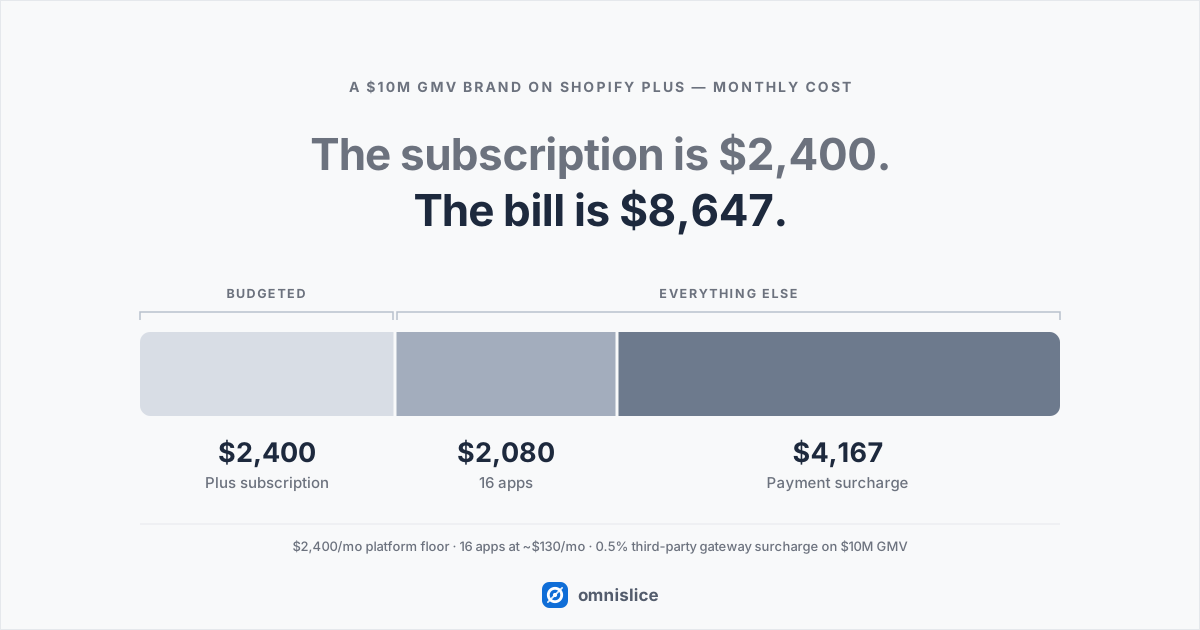
Adding it up for our $10M merchant:
- Platform subscription: $2,400
- App stack (16 apps): $2,080
- Third-party gateway surcharge (0.5%): $4,167
- Monthly total: $8,647
That is $103,764 a year, before implementation, before agency retainers, before the developer time to keep the integrations alive. The realistic all-in range for mid-market Plus brands lands somewhere between $4,000 and $10,000 a month once everything is counted — and the low end of that range assumes you are using the platform's own payments and running a lean app list.
The subscription — the number the entire buying conversation is organised around — is 28% of it.
The line item that never appears on any invoice
There is one more cost, and it is the one that never gets budgeted because there is no vendor to bill you for it.
When your catalogue lives in the platform, your stock lives in a sync app, your customer data lives in your email tool, your B2B pricing lives in a quoting app and your marketplace listings live somewhere else again, somebody has to hold all of that together. That somebody is on your payroll.
It shows up as:
- Reconciliation work. Hours every week spent confirming that the inventory number in one system matches the inventory number in another, because the sync runs on a schedule and the schedule does not care about your Black Friday.
- Overselling and underselling. Every sync interval is a window where two channels can sell the same unit. Oversell and you eat the refund and the reputational cost; undersell and you sit on stock you told a channel you did not have.
- Attribution chaos. When the order record, the email engagement and the ad spend live in three tools with three definitions of a customer, nobody can answer what a channel is actually worth. So the argument gets settled by whoever is loudest.
- Onboarding drag. A new ops hire has to learn nine systems and the undocumented conventions that connect them, instead of learning your business.
None of this appears in a TCO spreadsheet. It appears in headcount, in error rates, and in how long it takes you to launch a channel that a competitor launched last quarter.
You are not buying a platform. You are assembling one.
Once you total the invoice honestly, the framing of the whole decision changes.
The subscription does not buy you a complete commerce operation. It buys you a store engine and an app store — a starting point plus a marketplace where you can, at your own expense, purchase your way toward completeness. The apps are not optional extras bolted onto a finished product. They are the product, finished by you, at retail prices, with the integration risk transferred to your team.
So the real question was never "Shopify or an alternative." It is:
Do I want to assemble a platform, or run one that is already complete?
Those are different products with different cost curves. An assembled stack costs more the more you do — more channels, more apps, more integration surface, and a platform fee that climbs with your revenue. A complete platform costs what it costs.
What changes when the platform is already complete
This is the problem Omnislice was built for, so take the following as an argument rather than a neutral survey — but the mechanics are checkable.
- Every feature is included. CMS, commerce, email and SMS, promotions, B2B quoting and account pricing, multi-warehouse inventory and unified reporting ship as part of the platform. There is no app store to buy your way to a working product, so the app line on the invoice is not smaller — it is absent.
- No platform transaction fees. Your processor charges you what your processor charges you. Nothing is added on top, and no fee is attached to how much revenue you happen to make. Growing does not reprice you.
- Any payment processor. Keep the relationships and rates you negotiated, switch when it suits you, and pay no penalty for either.
- One source of truth. Catalogue, stock, pricing, orders and customers live in one operating core that every channel reads from. There is no sync window to lose a unit inside, because there is no sync.
- Published pricing. Flat tiers you can read on a page and put in a budget, not a custom quote that gets re-negotiated the year you have a good run.
The honest caveat: replacing an assembled stack is a migration, and migrations cost time. The point is not that switching is free. It is that the thing you are switching away from costs considerably more than the number on its quote — and unlike the migration, that cost recurs every month and grows with you.
Work out your own number
Ours is a worked example, not your invoice. The figures above use published July 2026 market pricing — a $2,400 monthly platform floor, 0.25% of monthly GMV past the threshold, 16 apps at roughly $130 each, and a 0.5% third-party gateway surcharge inside the 0.2%–2.0% range seen in market. Your real number depends on which apps you run and the rates you have negotiated.
So run your own. The savings calculator on our homepage opens on exactly the scenario above — $10M GMV, 16 apps, your own processor — and every assumption behind the maths is printed next to the result. Move the sliders to your business and see what the gap looks like.
Then go and pull your last three months of invoices. All of them, from every vendor. Add them up.
Most teams have never seen that total in one place. It is usually the most useful hour of the whole evaluation.